Hypnic Jerks: Why You Jolt Awake Just as You Fall Asleep
That sudden jolt at the edge of sleep is a brief misfire in the handover from waking to sleep, and sleep medicine classes it as benign.
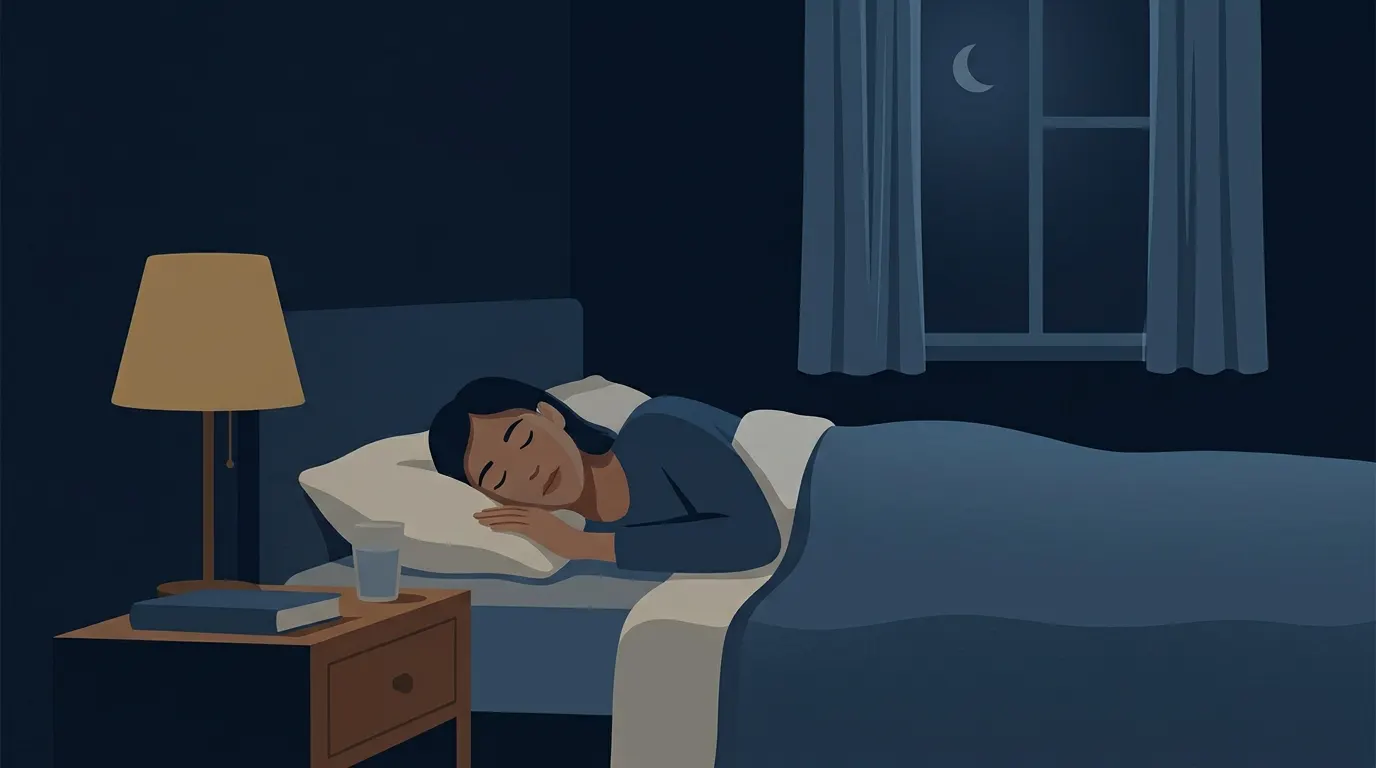
A hypnic jerk is a sudden, involuntary muscle twitch that happens as you fall asleep. Your brain's motor system is powering down for the night, and on the way out it sometimes fires one last burst down your motor nerves. Every muscle that burst reaches contracts at once. Sleep medicine classes it as benign, and about 70% of people get them.
Key points
- A hypnic jerk is one sudden burst of activity down your motor nerves as the brain's motor system powers down for sleep.
- The falling sensation may be your brain misreading relaxing muscles as a fall and firing its emergency response.
- Caffeine, sleep deprivation and stress make hypnic jerks more likely.
- Sleep medicine classes sleep starts as benign, and they happen to about 70% of people.
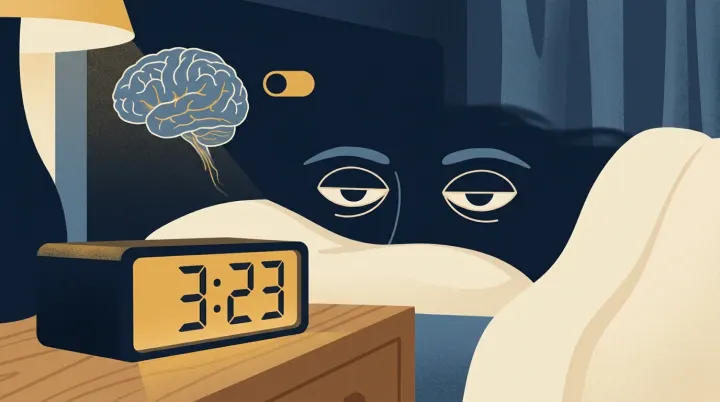
You know the scene. Your thoughts are going soft at the edges, and then your whole body jolts. Maybe you kicked, or felt the ground vanish. Now you are wide awake with your heart thumping, wondering what happened. This case file has the answer.
What is a hypnic jerk?
A hypnic jerk, also called a sleep start, is a single brief muscle contraction at the moment of sleep onset. The American Academy of Sleep Medicine lists sleep starts in its International Classification of Sleep Disorders as a benign sleep-related movement phenomenon (AASM, 2014).
Scientists have recorded them for decades. In 1959 the sleep researcher Ian Oswald wired volunteers to electrodes and recorded the jerks as they fell asleep. He found they were normal events in healthy people (Oswald, 1959).
On a recording, a hypnic jerk is one sharp spike of muscle activity lasting a fraction of a second. It sits against the slow, rolling waves of a brain settling into sleep. More than sixty years after Oswald, that picture has not changed. The spike is no seizure and no warning sign.
People explained the jolt long before electrodes existed. Old European folklore said a spirit was tugging your soul back into your body. Other traditions blamed witches, or a misstep on the staircase into the land of dreams.
Why does your body jolt as you fall asleep?
The jolt is a misfire during the handover from waking to sleep. Falling asleep is gradual. For a few minutes, control passes from the waking brain to the sleeping one, and the two do not change over cleanly.
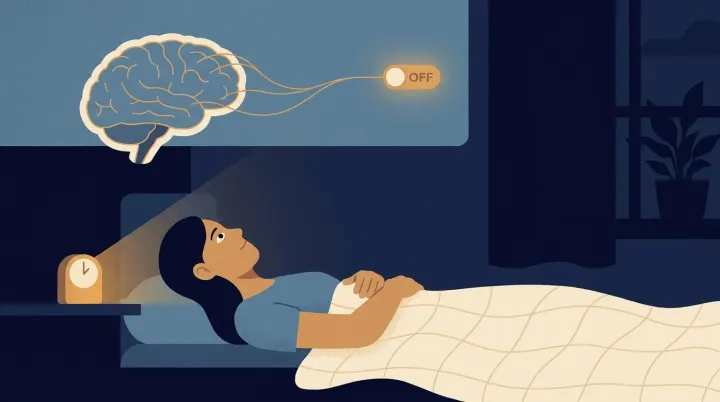
As you drift off you pass through a state called hypnagogia, the borderland between waking and sleep. Your muscles relax and your breathing slows. The motor system, the part of the brain that moves your body, starts to power down.
It does not power down all at once. Sometimes it sends one last sudden burst of activity down the motor nerves, and every muscle the burst reaches contracts at the same moment. That contraction is the jolt.
For a few minutes each night, nobody is fully holding the controls.
Sleep scientists divide the night into stages. The first, N1, is the shallowest. It lasts a few minutes, and you are easy to wake from it. N2 follows, with bursts of brain activity called sleep spindles, and then N3, deep sleep.
The hypnic jerk lives almost entirely in N1. That is why it strikes as you drift off and never in the small hours. If you find yourself awake later in the night, a different mechanism is at work.
Why does a hypnic jerk feel like falling?
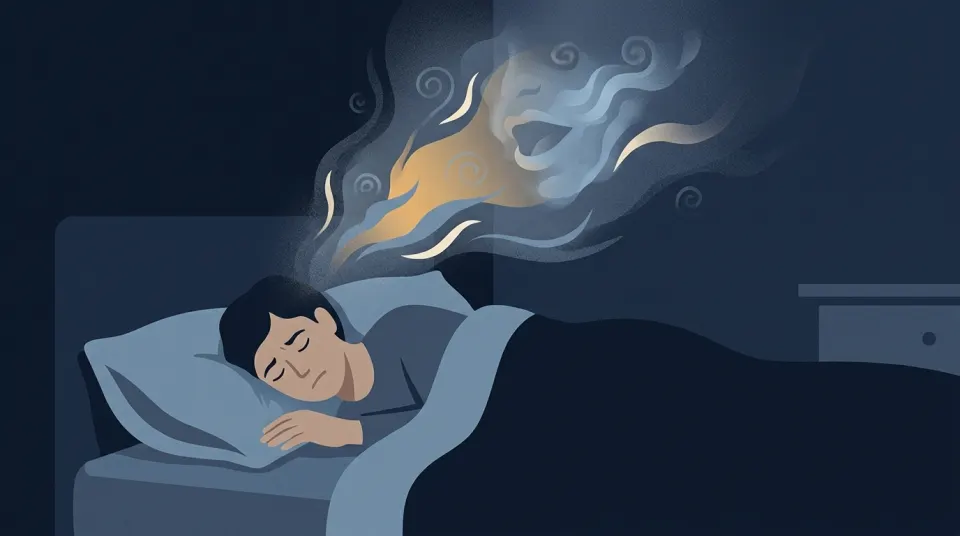
The falling sensation may be your brain choosing the wrong explanation for relaxing muscles. As you fall asleep your muscles go slack, and your brain notices. Slack muscles are also what happens when you fall.
In the borderland, with half its systems offline, the brain has little else to go on. Some researchers think it occasionally reads the signal as a fall and fires the emergency response. Your body does the rest.
One evolutionary idea goes further. Some psychologists have proposed that the reflex is a leftover from tree-sleeping primate ancestors, who needed to grab a branch before dropping out of the canopy. The idea is very hard to test, so file it under hypothesis and leave it there.
What else happens in the borderland before sleep?
The jolt has company. As you slide through hypnagogia, the line between thought and dream blurs. Some people hear their name called, see flashes of light or feel the bed tilt. These are hypnagogic hallucinations, brief and harmless dream fragments leaking into a brain that is not yet asleep.
A few people hear a sudden, deafening bang at the edge of sleep, like a gunshot or a slammed door that never happened. This is exploding head syndrome, and it is also classed as benign. It is the same kind of handover glitch, striking the hearing system instead of the muscles.
Salvador Dalí used this state on purpose. He dozed in a chair holding a heavy key over a metal plate. When sleep took him his muscles relaxed, the key dropped, and the clang woke him with surreal images still fresh. Thomas Edison reportedly did the same with steel balls.

What makes hypnic jerks more likely?
Three suspects keep turning up: caffeine, sleep deprivation and stress. Clinical reviews of sleep-transition movements flag the same list (Vetrugno & Montagna, 2011).
Caffeine matters most late in the day. It takes five to six hours for the caffeine in your blood to drop by half. Half of a four o'clock coffee is still circulating at nine, and a quarter of it is still there at two in the morning.
Stress keeps your arousal system revved up at the moment it should be standing down. Add a short night or two, and the handover gets rougher.
That explains a pattern you may have noticed yourself. The jolts show up on the nights you are overtired, wired or anxious, which are the nights you can least afford them.
The verdict
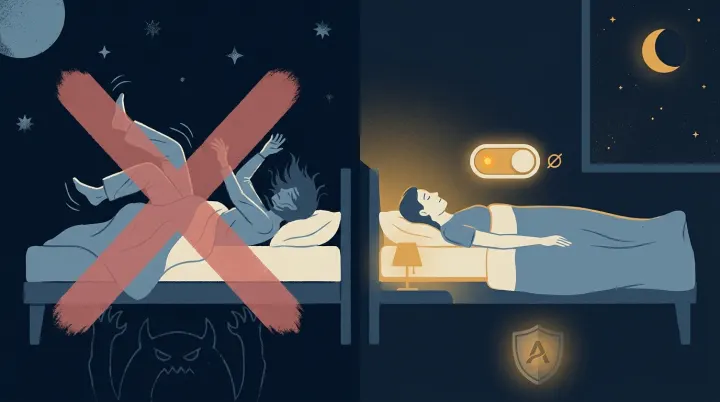
A hypnic jerk is a misfire in the handover from waking to sleep. Your motor system sends one stray burst on its way offline, and your muscles answer. It can feel like falling because your brain briefly picks the wrong story for muscles going slack. It is more likely when you are caffeinated, short of sleep or stressed, and it is benign.
What actually helps
The research points at ordinary habits. None of them is a treatment, and none is glamorous.
- Move caffeine earlier. Stopping after early afternoon leaves far less of it in your blood at bedtime.
- Wind down for an hour. Keep lights low and screens away, because bright light tells your body clock it is daytime. A book or a shower gives your mind somewhere quiet to land.
- Keep the bedroom cool. Your core temperature needs to drop about one degree for sleep to begin.
- Hold a consistent wake time. A rested brain makes a smoother handover, and this is the strongest of the four.
You will also see magnesium pitched for sleep jolts. For people who are deficient, it can help sleep quality a little. For everyone else the research is thin and the effects are small.
When to see a GP
The occasional jolt as you drift off needs no attention. It is a quirk of falling asleep and is not classed as a disorder.
A different pattern is worth mentioning to your GP or a sleep specialist. That means jerks many times a night, every night, or legs that twitch rhythmically through the night itself instead of only at sleep onset.
This article is educational and is not medical advice.
Quick answers
What is a hypnic jerk?
A hypnic jerk, or sleep start, is a sudden involuntary muscle contraction that happens as you fall asleep. The brain's motor system powers down unevenly and sometimes fires one last burst down the motor nerves. Sleep medicine classes it as a benign phenomenon, and about 70% of people get them.
Why does a hypnic jerk feel like falling?
As you drift off your muscles go slack, which is also what happens when you fall. In the half-asleep borderland state, some researchers think the brain occasionally picks the wrong explanation for that signal and fires its emergency response, so you jolt as if the ground had gone.
What makes hypnic jerks worse?
Clinical reviews of sleep-transition movements flag three things: caffeine, especially late in the day, sleep deprivation and stress. Stress keeps your arousal system revved up when it should be standing down, which is why the jolts tend to arrive on nights when you are overtired, wired or anxious.
Sources
- American Academy of Sleep Medicine (2014). International Classification of Sleep Disorders, 3rd ed. Darien, IL: American Academy of Sleep Medicine. View source ↗
- Oswald, I. (1959). Sudden bodily jerks on falling asleep. Brain, 82(1), 92-103. View source ↗
- Vetrugno, R. & Montagna, P. (2011). Sleep-to-wake transition movement disorders. Sleep Medicine, 12(Suppl 2), S11-S16. View source ↗
NightWise is educational content based on published sleep research. It is not medical advice. If something about your sleep worries you, speak to your GP or a sleep specialist.
Comments
Loading comments…